
AI word dump that ruins your brand and reputation
2.5 hours for an AI article no one reads. While I write content by hand in 2 hours that gets at least 3x more conversions.
Do you have this too? You want to publish valuable content without losing many productive hours and days, but sometimes it feels like I’m training an intern who doesn’t even belong in my company.
AI applications are damn bad at applying convincing power principles and they’re absolutely not going to help you get your (potential) clients on board with their transformation while using your service or product (which gets you better CLTV clients).
In my quest for easier and faster article and post creation, I’ve researched quite a few tools and methods. Almost every existing tool got an AI component from mid-2024 that they integrated and offered at extra cost. Those AI additions were actually all half-baked and came up with things that had nothing to do with convincing principles. Let alone understanding how my email and publication strategy is structured. Worthless...
My only hope was with ContextMinds, a tool that combines mind mapping (my favorite way of brainstorming) with article creation. Because I got a nice offer, I immediately purchased a Lifetime account hoping it would continue to develop. And hoping I’d get used to the AI application in the app. Connecting my ChatGPT (paid version) API to ContextMinds is handy.
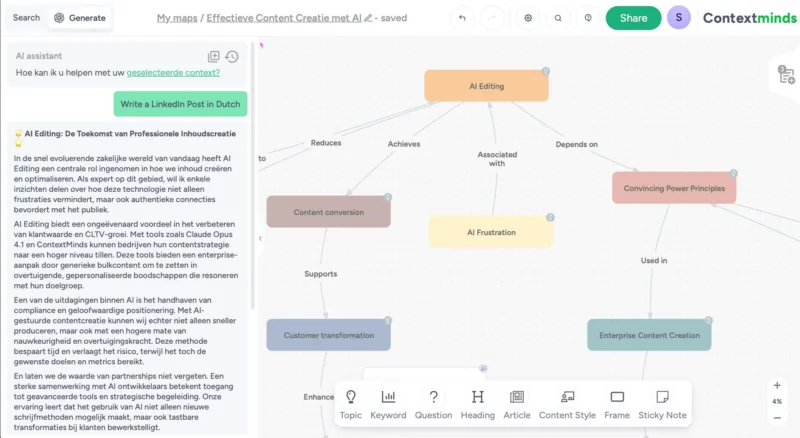
The AI output is continuously so bad that I have to throw it away every time; it doesn’t reach the level of ‘manual writing’. The app thinks in paragraphs but doesn’t really know how to create a convincing structure for the article, and keeps ‘forgetting’ the goal of the article. Combining paragraphs from different articles with ContextMinds also happens too randomly, causing me to lose another half hour. Even more generic ‘garbage’ that I don’t even want to read myself. A no-go.
Just like ChatGPT, it follows the standard writing style most commonly used on the internet; so not based on convincing principles, but more on reports and old-fashioned structure.
After quite a few hours and articles, the speed gain remains absent. An article with ContextMinds takes me at least 2.5 hours, while a first draft written by hand takes 1.5 hours. Then, I only need 0.5 hours to improve it with an AI agent...
AI tools sell time savings but deliver time loss.
What actually works?
My issue is that many AI agents can’t properly apply the convincing principles. Even with the recent Claude Opus 4.1, it’s apparently impossible to write both credibly AND persuasively. The agent can make the convincing principles 20% sharper and more consistent in 9 out of 10 draft texts I feed into the agent, that works fine.
So, I write the article as good as possible and let Claude improve it with a few iterations. That works and as far as I've experienced, it’s currently the best way to write both credibly AND persuasively.
Where AI agents are truly amazing is in rewriting and combining existing articles. For 2 of my corporate clients (including a listed company), I write articles as co-author for LinkedIn and their website. I train the AI agent by first uploading about 10 existing similar good articles from that specific client, so the style and format are known. And then I have the agent rewrite the first draft of the new article (in co-creation); that works well. Of course, this can only be done with text that is compliance-approved. AI as editor, not as writer.
From AI frustration to high value clients
What happens if you still choose the generic bulk approach? Yes, you get a lot of content, but it doesn’t help you achieve that 25% growth by transforming to a higher level for your clients. How credible do you think you are?
OK, if you want to remain a supplier of individual solutions and choose to compete on price, you’re choosing a vulnerable market position where you’re interchangeable with competitors because only price makes the difference. You miss the chance to transform to sparring partner of your high value clients, which could increase your CLTV by +25%. And your business builds up sufficient resources for expansion to other countries, or for introducing new services to strengthen your partnership position.
Challenge: test it yourself
Write one article by hand, improve it with your AI agent, and compare the results with your last 10 AI-first generated posts. Want extra feedback? Send it to me.
No time? Download my 3 case studies, which already incorporate the convincing power principles. Then you’ll immediately see the difference.
The method I describe above - manual writing, then improving with AI - is no accidental discovery. It comes from years of experience applying the Convincing Power Principles® for my clients.
These principles work because they focus on what truly matters: authentic connection with your client’s ambition, credible AND inspiring positioning, content that actually persuades by connecting with your client’s world. Instead of text and images that just fill space. Tapping into the ambitions of your clients and stakeholders yields more revenue in the long term. In the cases, you learn how to use this strategic approach smartly.
Evidence from practice
Curious how this approach works in practice? My case studies demonstrate how:
- A €60 million greenhouse project went from sabotage to success through the right positioning (not technology-first, but people-first)
- An IPO pitch deck convinced investors by making complex data visual and persuasive
- A software expansion failed because the entrepreneur underestimated the marketing effort - and what you can learn from it
Download the 3 FREE case studies where the Convincing Power Principles® are applied. Then you’ll see concretely how persuasive content works for innovative projects from 60 million to companies managing over 1 billion in assets (asset management, technology and manufacturing).